Overview
Swift & Secure: Self-Acting & Quick closing in less than 0.3 seconds!

Non-return valves are essential safety and performance components in steam turbine setups. They ensure the safe, efficient and controlled operation of the system by preventing backflow, regulating steam flow, and providing isolation capabilities. Quick Closing Non-Return Valves (QCNRV) are designed to prevent backflow to the turbine from extraction and bleed lines.
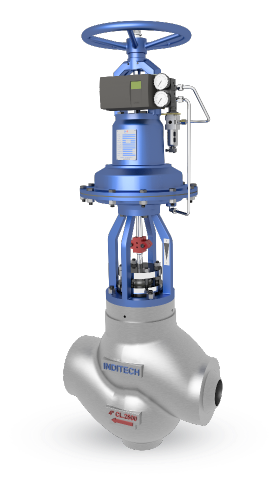
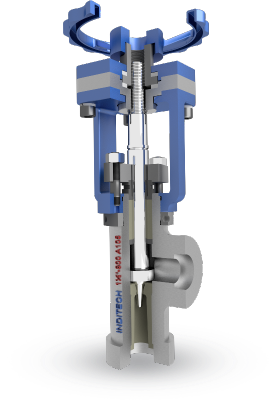
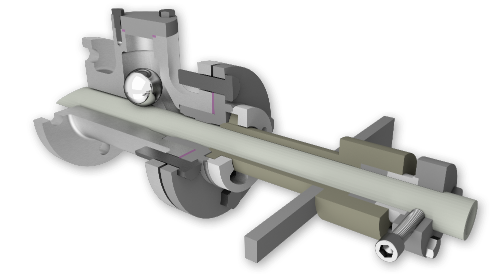
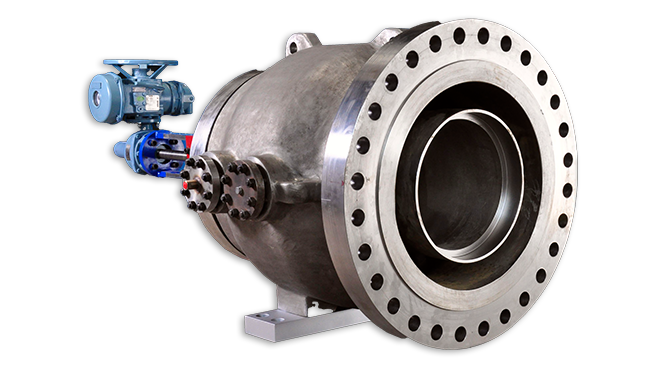
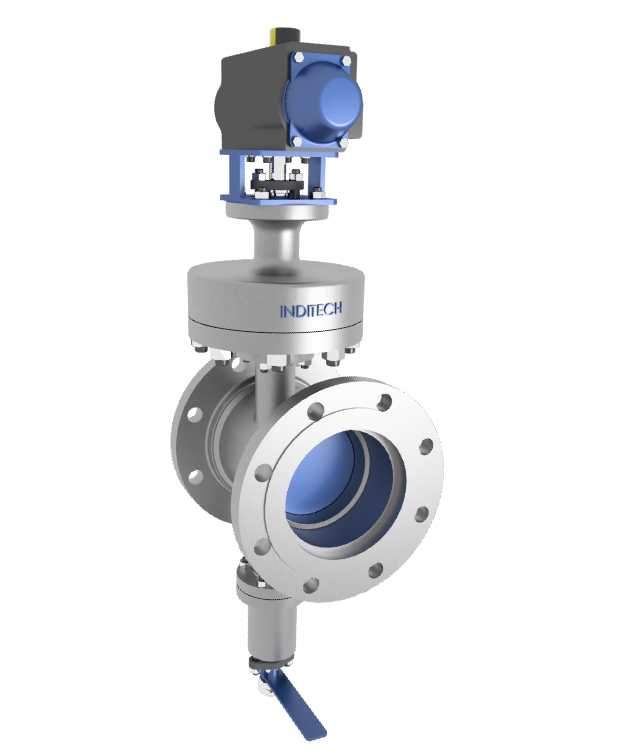
IndiTech’s tilting-disk type QCNRV is a specialised type of check valve known for its rapid closure and suitability for handling pulsating flows and compressible fluids. Instead of a hinged disc, this NRV uses an innovative design of a disc mounted on an eccentric shaft, which provides excellent sealing capabilities. The tilting disc ensures simultaneous regulation of flow over the disc and under the disc. This ensures dynamic balancing of the disc, enabling steady operation of the valve under all flow conditions. The disc’s conical shape and angled seat create a wedging effect during reverse flow, causing it to close rapidly and seal tightly.
IndiTech’s Series 350 is the first Tilting-Disc type QCNRV designed and manufactured in India.
Ensure instant shutoff with our industry-leading Quick Closing Non-Return Valves.
Applications
Turbine Trip Protection:
QCNRVs are widely used in Power Plants for safeguarding the turbine from the backflow of steam during trips, ensuring operator safety and equipment protection.
Steam Extraction/Bleed Line:
Cold Reheat Line:
Technical Data
350
NPS 4 To NPS 24 (DN100 To DN600)
ANSI CL150 To CL600
Steam/Water/Gas
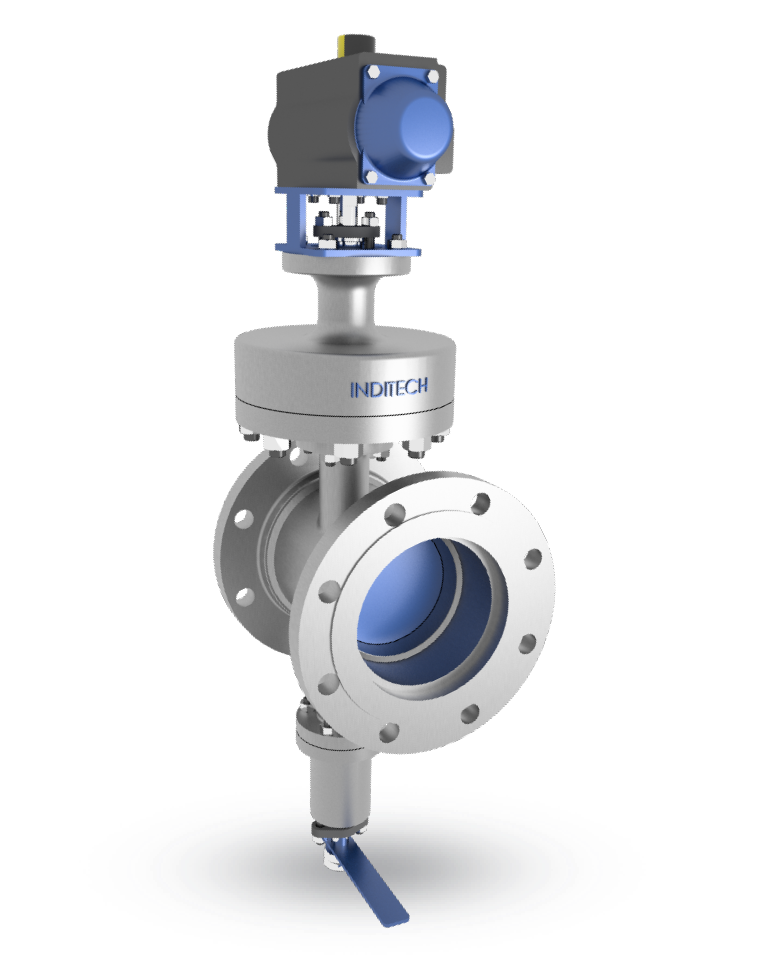
Flanged/Butt Welded
A216 WCB; A217 WC6/WC9; A351 CF8M
Normal operation (NRV) - Automatic
Emergency closing - Pneumatic
Features
- Self-acting and quick closing with the pneumatic actuator in less than 0.3 seconds
- Lightweight construction compared to bulky swing-type QCNRV
- Low-pressure loss
- Equipped with counterweight for balancing of disc
- Manual lever or test solenoid valve is provided to check disc movement in running condition
- Chatter-free operation: suitable for pulsating flows
- Guaranteed leak tightness as per API 598
- Suitable to be installed on horizontal as well as vertical pipelines
- Maintenance-free, long service life
FAQ
What is the primary function of a quick closing non-return valve?
A QCNRV is a fast-acting safety apparatus that allows fluid to flow in one directed manner, closing in less than half a second to avoid reverse movement. Its primary purpose lies in safeguarding delicate equipment, e.g., steam turbines, through the expensive and hazardous backflow scenarios in the event of a shutdown or trip.
How does a QCNRV protect a steam turbine?
Hot steam and condensate travelling in steam turbine extraction lines tend to rush back rapidly should a sudden trip occur in the turbine, which produces extreme thermal shock and mechanical destruction. A QCNRV will sense this reverse and close off immediately, isolating the turbine from the backflow, eliminating damage to the turbine blades and other components due to the catastrophic damage.
What is the difference between a QCNRV and a standard swing check valve?
Both would prevent reverse flow, but a swing check valve is dependent upon gravity and back-pressure, and thus flows slowly, and may cause a water hammer. The QCNRV, including the Series 350 available at IndiTech Valves, slams closed pneumatically or with spring assistance, to provide certainty of seal under emergency conditions where an ordinary check valve may close too slowly.
Where are QCNRVs considered essential equipment?
Backflow can be a serious risk in high-energy systems, and QCNRVs are therefore an essential part of it. They are common in the steam turbine extraction and cold reheat systems, in the pulverized coal injection system in steel mills, and in essential chemical and petroleum process systems. This has the benefit of eliminating expensive downtime and safety risks as well as long-term degradation of equipment.
What causes check valve “chatter,” and how does IndiTech Valve’s design avoid it?
Valve chatter occurs when the disc opens and closes at rapid rates due to turbulence or a changing flow, resulting in noise and wear. The tilting-disk QCNRV product of IndiTech Valves uses a dynamically balanced disk, which guarantees stability in performance, also under pulsating conditions. The design is chatter-free, offers minimal maintenance, and causes a large increment in the lifespan of the valve in operation.
Which materials are used in IndiTech Valves QCNRVs?
IndiTech Valves builds QCNRVs for demanding environments using robust materials. Alloy steels (A217 WC6/WC9) and Carbon Steel (A216 WCB) deal with high-temperature steam. Stainless Steel (A351 CF8M) is a corrosion-resistant material against aggressive fluids. In more extreme applications, special alloys such as Hastelloy or Monel are available, providing the greatest level of durability and service life.
What leakage performance can be expected?
Depending on the application, IndiTech Valves QCNRVs will pass or surpass API 598 leakage requirements to ensure the reliability of shut-off. Class V or Class VI shut-off levels are available, including bubble-tight performance, particularly for applications that may require extra-tight sealing. These standards were attained through precise machining, high-grade sealing materials, and rigorous testing, ensuring system security, energy conservation, and the valve’s long life.
Can QCNRVs be installed vertically?
Yes. The IndiTech Valves QCNRVs may be mounted in a horizontal or a vertical manner (upward flow) without influencing their performance. All orientations are optimised to provide quick closure and a hard seal in the internal geometry and actuator design. Such flexibility applies well to retrofits, compact designs, and in the unusual plant designs without reducing the requirements of reliability or safety.
How fast does an IndiTech Valves QCNRV close?
Our QCNRVs have been designed to operate at very high speeds as they can close completely within less than 0.3 seconds. Such fast reaction time offers essential safeguarding to turbines, boilers, and process lines, avoiding damage due to sudden backflow incidents. The acceleration remains consistent with the position and conditions of installation as well as the protection operating. This gives reliable protection.